Tips on raising a
Cocker Spaniel
A few things I've learned after
45+ years with Cocker Spaniels

Tips on raising a
|
|
The most important thing to do during the first few months with your new dog is to spend absolutely every possible minute with it. Cockers are people lovers, it's as simple as that. Banish a Cocker to the back yard 23 hours a day and you're going to end up with a crazed Cocker.
The second most important tip I can offer: give your dog lots of exercise every day. The more you can tire your puppy out, the less behavior problems you will have with it. Go for lots of walks, and teach it to chase and retrieve toys. Keep the pup in motion as much as possible, and his/her behavior will be so much better at home. An exhausted puppy causes no trouble!
Keep your puppy within your sight at all times. Close doors or use baby gates in doorways to keep the puppy confined to the same room you are in. Do not let the puppy wander throughout the house unsupervised! If you can't watch the puppy, place it in the care of someone who can. If no one can watch the puppy, put it in a crate until you are able to watch it again.
The first few months that you have the dog are extremely important for forming a special bond between you and the puppy. Take a week or two off from work so that you can spend some extra time with the puppy when you first get it. Let the puppy sleep in your bed, or in a crate on or next to your bed, so that the puppy feels like it is with you all night long.
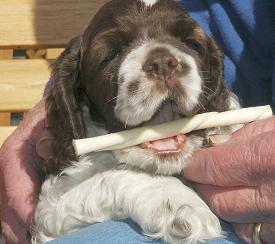 Puppies
love to chew things, and will frequently try to chew you or your clothing.
When this occurs, stick a chew toy in the puppy's mouth. There's no way to get a
puppy to not chew things... the trick is to keep the puppy busy chewing
things you WANT it to chew.
Puppies
love to chew things, and will frequently try to chew you or your clothing.
When this occurs, stick a chew toy in the puppy's mouth. There's no way to get a
puppy to not chew things... the trick is to keep the puppy busy chewing
things you WANT it to chew.
Have a wide variety of chew toys available for the dog. Go to the pet store and buy about a dozen different chew toys in an assortment of shapes and textures. When buying toys for puppies, be sure to buy SMALL toys! You'll want some hard chew toys such as rawhide chews, as well as some soft chew toys such as plush "beanie-baby" type toys. I frequently get email from people who say their puppy is ignoring his toys but is always biting people instead. When I ask for an inventory or a picture of the dog's toys, the answer is usually clear: bad choice of dog toys! Buy a large variety of toys, and once you find what the dog likes, buy more that are similar but different to his favorites. Also, a word of caution about rawhide chew toys: these are fine as long as you are supervising, but don't leave rawhide toys with your dog for long periods. If the dog is given enough time, he will chew that rawhide toy in to small pieces. If he were to swallow one of those pieces, it could cause a major problem.
Make sure your kids understand one important fact... there is no such thing as play fighting with a dog. The kids should be encouraged to play with the dog, but they must never ever play in such a way that the dog is encouraged to bite or do anything mean... or in a way that the dog would find scary. Your kids can very easily turn your dog mean if you let them just act like kids naturally do with a puppy. You've got to train your kids to treat the puppy softly and gently at all times, even at play time. Make sure everyone knows that "Tug-o-war" is not OK, too... it teaches the dog to work against you, and it's also a good way to mess up the dog's teeth.
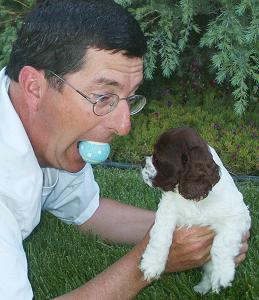 Use positive reinforcement, not negative.
In other words, be full of praise for the puppy when he does good,
but go easy on scolding him when he does bad.
(Ladies, here's a marital tip: This technique works well on husbands, too.)
Of course, you will occasionally need to communicate your unhappiness to the dog
when it does something bad. Try to keep it simple and just use the word
"NO!". You'd be amazed at how much a stern "NO!" and an unhappy look on your
face can communicate. (Ladies, this technique will not be appreciated by
your husband.) For situations where your puppy does not respond to "NO!",
keep a squirt gun or a squirt bottle on hand and just give a little squirt to
let the puppy know when he's gone way over the line. (Another technique
NOT recommended for use on husbands.) After a while, just the sight of the
squirt gun will get your puppy to behave.
Use positive reinforcement, not negative.
In other words, be full of praise for the puppy when he does good,
but go easy on scolding him when he does bad.
(Ladies, here's a marital tip: This technique works well on husbands, too.)
Of course, you will occasionally need to communicate your unhappiness to the dog
when it does something bad. Try to keep it simple and just use the word
"NO!". You'd be amazed at how much a stern "NO!" and an unhappy look on your
face can communicate. (Ladies, this technique will not be appreciated by
your husband.) For situations where your puppy does not respond to "NO!",
keep a squirt gun or a squirt bottle on hand and just give a little squirt to
let the puppy know when he's gone way over the line. (Another technique
NOT recommended for use on husbands.) After a while, just the sight of the
squirt gun will get your puppy to behave.
Teach your puppy to retrieve a tennis ball or other toy. 10 minutes of tennis ball retrieving in the evening will help keep your Cocker in good shape, and requires a lot less of your energy than taking the dog for a walk. (While the dog runs his tail off retrieving stuff, yours can be firmly planted in a chair.) If your dog is not a natural tennis ball chaser, it is a skill that can be taught. Start by tossing your dog's favorite toy a few feet away. Once you get your dog interested in retrieving it, gradually increase the distance that you throw it. Once the dog gets the hang of the game, it will retrieve just about anything you toss.
Take your dog for long walks. The more exercise you give the dog, the more he will sleep the rest of the day. A bored dog with lots of excess energy and nothing to do will chew things and misbehave. A dog who is constantly exhausted from playing ball and going for walks will sleep, not misbehave.
 Teaching a puppy to walk on a leash can be difficult at first.
They usually spend a lot of time fighting the leash the first few times you try
to use one on them. But there's a simple trick that works amazingly
well... it will make your puppy completely forget about the leash.
The first few times you take your dog on a walk with a leash, have someone else
walk another dog in front of you. It's something like getting a donkey to
walk forward by dangling a carrot in front of his head... if you have
someone walk an older dog a few steps in front of you and your puppy, your pup
will spend all her energy trying to catch up to the other dog and will totally
ignore the fact that she is wearing a leash.
Teaching a puppy to walk on a leash can be difficult at first.
They usually spend a lot of time fighting the leash the first few times you try
to use one on them. But there's a simple trick that works amazingly
well... it will make your puppy completely forget about the leash.
The first few times you take your dog on a walk with a leash, have someone else
walk another dog in front of you. It's something like getting a donkey to
walk forward by dangling a carrot in front of his head... if you have
someone walk an older dog a few steps in front of you and your puppy, your pup
will spend all her energy trying to catch up to the other dog and will totally
ignore the fact that she is wearing a leash.
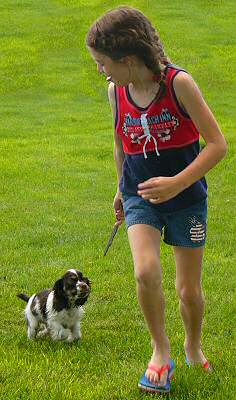 With a little planning, you can get your puppy to sleep when you want him to. For example, let's say you
know your favorite TV show is coming on at 7 PM and you do not want the puppy demanding your attention at that time.
Give the puppy some strenuous exercise about one hour prior to when you want her all pooped out.
Getting the dog to retrieve tennis balls is good, but another technique that
has always worked well for me is to get one of the kids to go out on the lawn and start running around. The puppy just naturally runs
right along with. It only takes about ten minutes of "puppy chasing the
kid" to
poop out the pup. It might temporarily get her all hyped up, but about an hour later
she'll be sleeping like a baby.
It's good for your kids, too!
With a little planning, you can get your puppy to sleep when you want him to. For example, let's say you
know your favorite TV show is coming on at 7 PM and you do not want the puppy demanding your attention at that time.
Give the puppy some strenuous exercise about one hour prior to when you want her all pooped out.
Getting the dog to retrieve tennis balls is good, but another technique that
has always worked well for me is to get one of the kids to go out on the lawn and start running around. The puppy just naturally runs
right along with. It only takes about ten minutes of "puppy chasing the
kid" to
poop out the pup. It might temporarily get her all hyped up, but about an hour later
she'll be sleeping like a baby.
It's good for your kids, too!
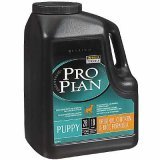 Feed
your puppy a good dry commercial dog food. We use
the puppy version of Purina
Pro Plan until the dog is one year old, and then we switch the adult version. Don't feed canned dog food, and don't give the puppy any human
food. You do not need to ration the dry food, or serve small portions of
it at certain times of the day... just put out a nice big bowl of dry food
and a nice big bowl of water, and the puppy will regulate her own intake.
This is called "free feeding". Don't worry... your puppy will NOT
get fat from overfeeding as long as all you feed is a dry food.
Feed
your puppy a good dry commercial dog food. We use
the puppy version of Purina
Pro Plan until the dog is one year old, and then we switch the adult version. Don't feed canned dog food, and don't give the puppy any human
food. You do not need to ration the dry food, or serve small portions of
it at certain times of the day... just put out a nice big bowl of dry food
and a nice big bowl of water, and the puppy will regulate her own intake.
This is called "free feeding". Don't worry... your puppy will NOT
get fat from overfeeding as long as all you feed is a dry food.
Can't find Purina Pro Plan in your local stores?
Click here to buy it online and to see other products that I recommend for
Cocker Spaniels.
Many Cockers have the unfortunate tendency to pee when excited or scared. The most important thing to know about this is to NEVER scold your dog for this... it would only make the situation worse. There are some very good tips about dealing with submissive urination and excited urination (two separate but similar problems) at http://www.ddfl.org/behavior/submissive-uri.pdf
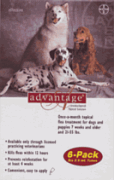 If you notice even a single flea on your puppy,
run
(or drive) to your local pet store and buy some "Advantage". This stuff is SO great... I don't know
how we ever got along without it. Don't waste your money on flea sprays, powders, collars, etc. They work about
as well in the fight against fleas as Suzanne Somers' "Thighmaster" works
in the fight against middle age. But there's an important point to
remember when using flea products like Advantage... it's only half the
battle. Topical flea products kill the fleas on your pet, but you also
need to deal with the fleas that are not yet on your pet! Go to your local
hardware store or home improvement store and get some advice on the best ways to
kill the fleas in your lawn and inside your home. If you don't do that,
you'll just have a whole new set of fleas on your dog in a week or two.
If you notice even a single flea on your puppy,
run
(or drive) to your local pet store and buy some "Advantage". This stuff is SO great... I don't know
how we ever got along without it. Don't waste your money on flea sprays, powders, collars, etc. They work about
as well in the fight against fleas as Suzanne Somers' "Thighmaster" works
in the fight against middle age. But there's an important point to
remember when using flea products like Advantage... it's only half the
battle. Topical flea products kill the fleas on your pet, but you also
need to deal with the fleas that are not yet on your pet! Go to your local
hardware store or home improvement store and get some advice on the best ways to
kill the fleas in your lawn and inside your home. If you don't do that,
you'll just have a whole new set of fleas on your dog in a week or two.
One other item I would like to strongly recommend... a television show on The National Geographic Channel called "The Dog Whisperer". This is the best show about dog training that I've ever seen. It's full of great information, and all dog owners should see this! Acutally, it's not about training dogs... it's all about training dog owners to be "the pack leader". If you can't get The National Geographic Channel on your TV, or if you missed the first season of the show... order the DVD and you will learn a lot!
If you've got a new puppy in your life, join our Cocker Spaniel Forum and get advice from other Cocker owners who have been in your shoes. Joining the forum is free, and I think you will really enjoy it. We've got over 700 members... and it's the most active Cocker Spaniel forum on the Internet.
I'd like to share with you a question I received via email recently. This is a real question from a real person, and my complete reply to her. (Although I did edit her question down a bit since the original was quite lengthy.) I think it's such a good question, and the response is so important, that I want to let you in on it...
 We have a two-year-old
female Cocker and an eleven-month-old male. We have several friends and
family members who are interested in a puppy. My question is: is our
male dog old enough to breed? I can't seem to find this information
anywhere on the Internet.
We have a two-year-old
female Cocker and an eleven-month-old male. We have several friends and
family members who are interested in a puppy. My question is: is our
male dog old enough to breed? I can't seem to find this information
anywhere on the Internet.

What else have I learned as a breeder of Cocker puppies? Read my tips on buying a Cocker puppy and my tips on potty training a Cocker puppy. You'll also find some useful information in my list of frequently asked questions.
There is a LOT more to this web site than just this page!
Please explore the rest of the site by viewing our table of contents,
or by clicking on one of the quick links below.
All About Our Cockers Meet Jim Zim Contact Jim Zim